The World Inside the Constellations
A response to Scott Mills

In his article “You are Not What They Named You,” my friend Scott says I think in constellations. I want to tell you what it feels like to see from inside one.
As he said, my hands move when I talk. They move a lot. I was taught to sit on them, to be still, so people can focus on hearing my words. Not only did I learn to hold still, but I also learned to compress. I worked hard to give people the version they could receive, maybe.
Before I learned to translate with words, I translated with my body. Through seventeen years of a dance career, the stage was the only place I never had to sit on my hands in order to communicate.
Isadora Duncan said the soul lives in the solar plexus. I’ve felt that warm origination point in the center as something comes to life, grows, and flows outward. An arm sweeps. A foot jiggles. A rush of steps bursts and stops abruptly. The face responds: tender, sad, passionate, relieved, amused, joyful, serene.
My dance teachers told me my face was too expressive. They said, “Let the body tell the story.” My face is a part of my body. Like my hands are. I am one organism, moving from the inside out.
My father wondered at my shyness. My difficulty in groups, in conversation. Then he’d watch me perform and say, “Wendy is tough as nails in front of an audience. She can do or be anything on stage.”
He wasn’t wrong about either thing. In normal life, I was working so hard to cram myself into the small boxes of neurotypical thought and conversation. I was always managing the signal.
Sitting on my hands.
On stage, the world inside the constellations could move the body from within. The audience could feel it. Sometimes, just watching me feel it was enough.
In 2019 I started trying to find words for it.
I was thinking about systems from the perspective of the human cell as a microscopic system. Millions of minuscule entities combine into organs, circulation, and into the larger ecosystems of the world. I wrote: “What would it be like if we started to notice the ecosystems in which we play a part?”
Underneath that question, I was asking whether I was a healthy cell. Was I sending the right signals? I’d been spending time with a therapist working in the tradition of Joanna Macy, whose frame was about attachment, personal evolution, and the role we play in our ecosystems. It helped me see things I needed to see.
It was also still a form of translation. I was still asking: Am I acceptable? Am I functional? Am I doing it right?
I don’t ask those questions anymore.
I just am.
They just are.
I try. I feel. I grieve. I heal. I hurt. I feel joy. I love. I lose. I try again.
I ask, “How can we best love each other?” and show up again.
I notice what hurts me and either share it or move away if the other person doesn’t seem to care.
I still see the patterns, the constellations, and the way light moves through the web. I’m inside it now.
Made of it.
Scott writes about the relief of being named correctly. The body exhales when it is finally, accurately named.
Yes. And something comes after the naming.
After the exhale, you learn to breathe again on your own. The accurate name is a gift. You are the organism the name was trying to describe. The organism already knew. It was in the hands all along. It’s in the facial expressions that the teachers tried to quiet. It lives in the solar plexus, where something begins to grow and flow before language arrives.
The table Scott describes — where the translation tax drops, and you are met in the original language — I have found it.
I am still finding it.
What I bring is the knowledge of what it feels like to live inside a constellation.
The darkness between the stars.
The warmth at the center.
The body that was always, underneath the stillness, telling the truth.
Pull up a chair. Sit down.
Or not.
Move your hands if you want.
Jiggle a foot.
Stand and take a bow.
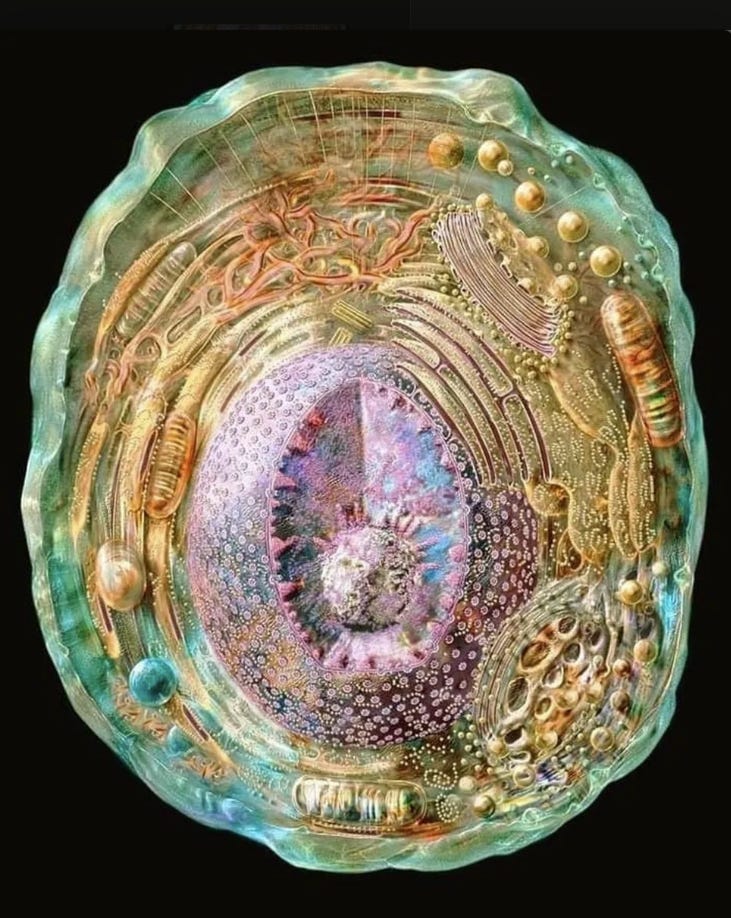
Artistic rendering of a eukaryotic cell by Evan Ingersoll and Gael McGill