That Tracks
A commute, a freight train, and the long arc from carrying everything to carrying nothing

The freight train remains still on the bridge for a long time.
I stand on the platform at the Vancouver Amtrak station and watch it cross the Columbia River, car after car after car, in no apparent hurry to be anywhere — a Schneider container in safety orange, a faded green box stenciled EMP, and behind them a long articulated spine of double-stacked steel, each stamped with the arithmetic of its own burden.
Well load limit 124,600.
Sixty-two tons in a single car, and there are more cars than I can count, strung across the trusses like beads too heavy for their string. The yellow signs at the switch read T-30, P-30, F-30: thirty miles an hour for everything, freight and passenger alike, because a structure carrying this much mass cannot be asked to do anything very quickly.
The train creaks and groans as it comes, a sound like the whole idea of weight complaining about itself, and I feel the low frequency of it in my sternum before I hear it in my ears.
I marvel at the heft.
There is something almost obscene about it, the sheer tonnage moving on a cushion of squealing metal springs and steel wheels riding the metal rails — a system so dependent on hardness and the refusal of one rigid thing to yield to another, that it can roll a thousand tons forward on a contact patch the size of a dime.
It is, when you think about it, a wildly inefficient way to be in the world.
So much structure.
So much groaning.
So many tons of things being dragged from one place to another because we have decided they need to be somewhere else.
I can tell the rails have always run through the rough part of town, the industrial spine where the land is cheapest, and the work is dirtiest. There are scrap heaps and grain silos and a yard of crushed aluminum gone soft silver in the morning light. It is grungy. It is exactly the kind of place a person hurries through on the way to somewhere prettier.
But I have learned to look at the edges.
Up the chain-link fence, black cottonwood and willow are climbing. Himalayan blackberry, that gorgeous invading thug, is pouring over the scrap. These are the pioneers, the first plants to colonize disturbed and broken ground, and they are here for the same reason the cement plant is here — water.
Cottonwood and willow are obligate riparian species, which is a botanist’s way of saying they cannot live without getting their feet wet. Where they thrive, the water table is high and near the surface.
You can read the hydrology of a place by who shows up to grow there, and these green colonizers were telling me, plainly, that beneath all that gravel and slag, the ground is soaked.
It must be very wet out there, I thought, the way you’d note the details of a friend. The disturbed ground does not stay bare. It is never allowed to. Something always moves into the wound and begins, immediately, the patient work of closing it.
I have spent the better part of my life being like this freight train.
For more than two decades, I was the one people depended on, the one who ran toward the disturbance — the landslide above the stream full of endangered fish, the burned-over slope sloughing its soil into the watershed, the fire itself. I was a Forest Service soil scientist and a deputy district ranger; I carried the load across the bridge and held it as long as it took.
This past year, I set the load down, and the strange, disorienting grace of it is that the bridge did not collapse.
The world did not require my tonnage to survive.
The Cascades train pulls in beside the freight, old and battered, built to carry people rather than cargo, and I board and find a seat on the riverside and feel the train pull north. Within a few miles, something in my body releases and matches the rhythm of the rails — the gentle, repetitive, side-to-side rocking that the vestibular system reads as safe, rhythmic, no threat here, the same input a parent supplies when they sway a baby without thinking.
My nervous system downshifts.
A silence arrives that is not the absence of sound but the presence of ease, and I sink into it.
Outside the moving window, the rivers shimmer green, holding the doubled image of sky and trees. The clouds roll over in shades of gray and white with sudden, astonishing windows of blue. The fields, green only last weekend, have gone gold — the heat wave reached down into them and pulled the water up and out, and the grasses did the only thing grasses can do under that kind of stress, which is to surrender the green, let the chlorophyll break down, and go dormant to protect the crown and the roots.
They are not dead.
They are waiting.
On these soft gray days, it is almost impossible to believe the heat was ever here, but the evidence is written in the color of the hills, and a few stops later, as we slow through a town, I look down at a bare patch of soil between the dormant bunchgrasses and see the small dark mouths of ant galleries opening in the exposed dirt.
Even there on the hard-packed earth.
The ants are soil engineers, turning, aerating, and carrying organic matter down into the mineral horizons, building structure in the very ground the drought left barren. Disturbance, and then the patient builders move into the gap. The pattern repeats at every scale.
And then a herd of cows just flashes past the window.
They are, in fact, ambling. But I know the right word for it, because my grandmother gave it to me. There is a small book, written in 1890 by a nine-year-old English girl named Daisy Ashford, in which a young woman named Ethel, bored to tears by a man boasting about his wealthy friend, turns to look out the train at some “cows flashing past the window.”
My grandmother — who milked her own cows on a three-legged stool and chatted to me about the Book of James while the warm milk hissed into the pail — was tickled by that line her whole life.
Cows, flashing.
As though the cows were the ones in a hurry and not the train.
It is a child’s mistake that is not a mistake at all; it is precisely how a window works, the near things smearing while the far things drift. And it is also, I understand now, a nine-year-old’s flawless rendering of a woman who has decided to stop listening to a man’s ego pitch and watch the world go by instead.
An older Daisy wrote that she used to pray for bad weather so she could stay inside and write. A child who longed for gray days. She would have loved it here, in this green and dripping country, and for one moment, with the real cows smearing past two centuries downstream of her pen, my grandmother is in the railcar with me, utterly delighted.
A friend calls, feeling caged in her work, and asks me to be her window.
“Tell me what you see.”
So I give her the gold fields and the wet northwest river jungle and the heat that dried it all, and she tells me she loves jungles, and so do I, and she drives toward the coast as we talk until the cell service thins and the call drops at the exact moment she reaches the ocean.
I let her go.
I trust the ocean to carry her the rest of the way.
This is the thing I keep having to learn. The feelings that move through a day are not interruptions to life; they are life itself in motion. The trouble starts only when I mistake the passing mood for the whole of me, when a grief or a fear that was meant to move through the body instead decides to move in, to take up residence, to become a permanent tenant rather than passing weather.
And the sky, all this gray morning, has been demonstrating the alternative. Storm and clearing are held in the same frame. The sky does not clench against the rain or hold its breath against the wind. It simply holds the weather and is not damaged by it, the way I am learning that I can sit with even a very large feeling and stay intact, without needing it to shrink or resolve itself first.
I used to believe courage meant becoming the kind of person nothing could touch.
Fireproof.
Invincible.
A foot of shaggy redwood bark between my core and every flame.
I am learning, late and slowly, that it is something much smaller and much harder than invincibility — that it is only the willingness to stop running. To stand still in the actual day, scrap heaps and salal alike, and love it without first demanding that it become beautiful.
My worth, it turns out, was never the tonnage. I am not required to haul anything across any bridge in order to be permitted to exist. Nature settled the question of my value the moment I was born, the same way it settles it for cottonwoods and coyotes and the small dark builders tunneling in the drought-struck ground. Worthy on arrival, like everything else that grows here. That one took me about fifty years to learn.
The Olympia-Lacey station is the photographic negative of where I began — small, safe, set down gently on the edge of farms and quiet neighborhoods. I sit in the sun and listen to birdsong and read a friend’s account of a coyote stalking a beaver out in the Nisqually National Wildlife Refuge, which is right there, ten minutes off, where the Nisqually River meanders down through its delta into the southern reach of Puget Sound. A predator hunting the original wetland engineer at the muddy edge of the marsh — the whole drama of the estuary in a single sentence, read on a sunny platform while I wait for the train that will carry me home.
And then the marsh hands me my own wildlife moment.
Something crosses the road in front of me as I leave — low to the ground, dark, blunt, tailless, shaped like an oversized prairie dog, humping across the centerline and gone into the brush before I can resolve it.
It’s not a squirrel.
…or a nutria…
A nutria trails that long naked rat’s tail behind it like a rudder, and this animal had none.
I sat with the mystery for a while, the way a soil scientist learns to sit with an unkeyed sample rather than force it into the wrong taxon, and only later let myself believe what I think it was: a mountain beaver.
Aplodontia rufa.
The most primitive living rodent on Earth, a creature so ancient and so poorly equipped that its kidneys cannot concentrate urine the way a modern rodent’s can, which means it must live where water is constant, and shade is deep, drinking nearly its own weight in moisture, venturing out mostly under the cover of dark.
To see one crossing a road in daylight is genuinely strange — but I had just ridden through a week of heat that pulled the water out of an entire landscape, and a mountain beaver whose damp burrow had gone dry is exactly the sort of being that might be forced out into the bright, dangerous open to go looking for wetter ground.
The day kept rhyming for me as the map on my phone instructed me to turn right on the path, and the “path” was a strip of mown green cut straight through a field gone to seed, aimed at a dark doorway in the firs. Even the navigation, it seemed, had a sense of humor.
I took the path.
The rain begins to pelt exactly as my Uber arrives.
I’m reminded how much I love the intimacy of Northwest trees in the rain — the way I can almost hear them murmuring “This is life, drink it in!” — and knowing the mechanism only makes the tenderness sharper.
When the rain comes, the trees do not so much drink it up as let the sky’s pull and their own thirst conspire: water evaporating from the leaves at the very top creates a tension that runs all the way down the unbroken threads of water in the xylem, a column held together by nothing but the mutual attraction of one water molecule for the next, so that a fir can lift a river two hundred feet into the air against gravity using no pump at all, only cohesion and the longing of the sky.
The rain wets the canopy, drips through to the duff, soaks down to where the mycorrhizal fungi lace every root tip to every other, the soil network waking in the wet, and the whole forest does precisely what the trees told me it was doing — drinking life in.
Last week, I spent the heat wave watching the fields go gold and dormant. Now the rain has come, and the trees say this is life, and they are not being poetic.
A year ago I was still the freight train, still holding the bridge, still certain that my weight was the only thing keeping anything aloft.
I traced the whole arc of it this morning almost without meaning to, watching the country roll by: learning what leadership actually asks; grieving the work and the people and the fire; wondering who on earth I am without the running-toward; surrendering, at last, to being nobody and nothing in particular — except someone who is loved, and finding that this was not only enough, but more than enough.
The fear of not being able to breathe, and the breath returning.
Rolling with the changes.
Landing, finally, at home.
It is an arc that ends, I notice, on breath and water — on a wet platform in a green country that felt like ease the moment I arrived in it. The heaviest thing I saw all day was a freight train groaning under its load on a bridge it was barely permitted to cross.
The lightest was the rain, arriving without effort, asked for and received. And I rode the whole long country between them, calm, carrying nothing, but valuable anyway.
I tilted my face to the gray sky, the way I have tilted it ten thousand times, and let the rain find me.
“Thank you,” I said, “for letting me be a part of this life.”
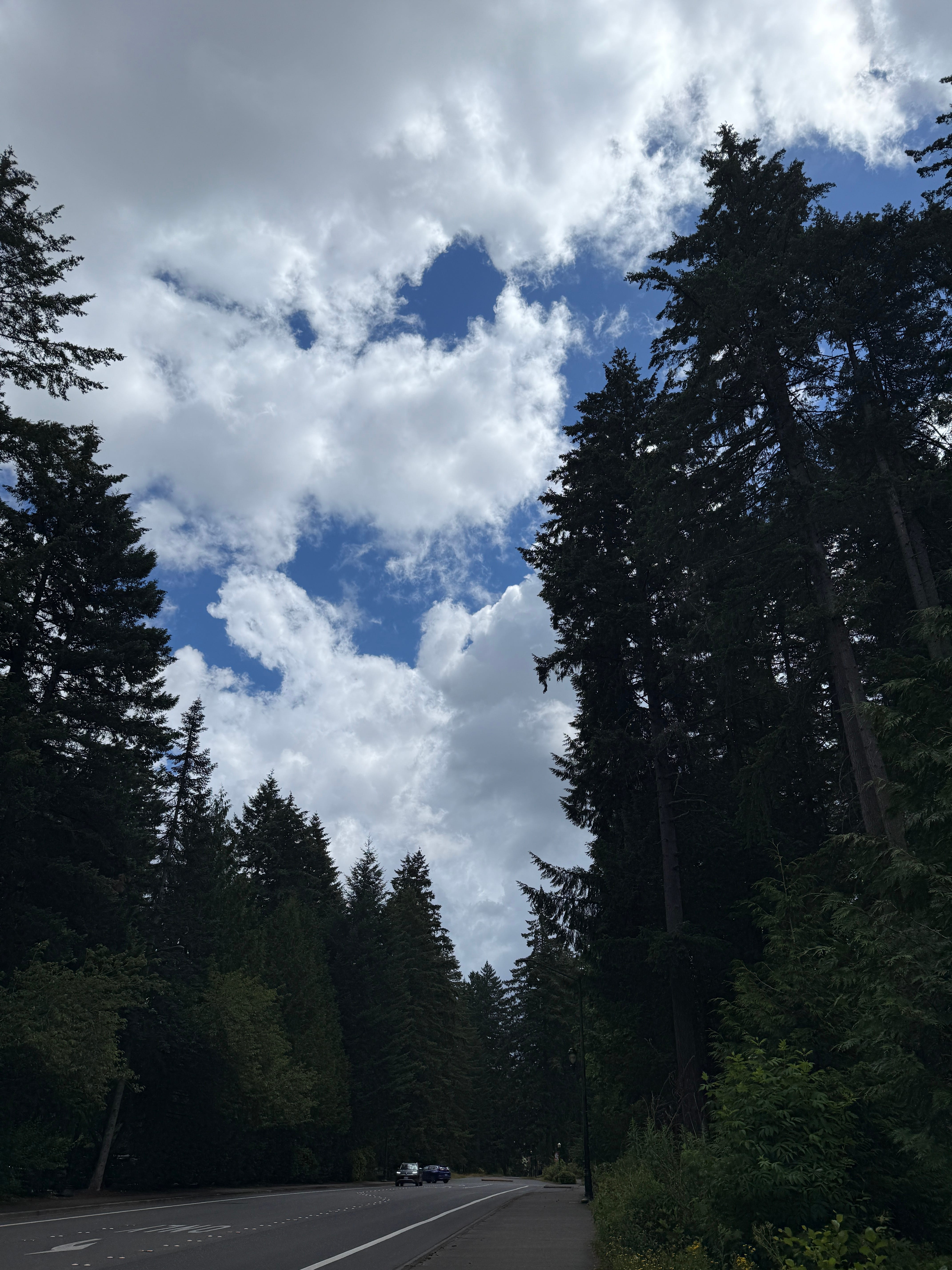
Photo by Wendy Peterman, Lacey, WA 2026
"The world did not require my tonnage to survive." ❤️
Beautiful Wendy. Thank you for painting life with your words. 💗