Bodies in Motion

Bodies in Motion
Newton’s first law of motion states that a body in motion tends to stay in motion, and a body at rest tends to stay at rest, unless acted upon by an outside force.
---
A week before I left Salt Lake City for good, my inner ear staged a revolt.
It started quietly — a mild dizziness when I turned over in the night, a sense of the ground shifting under me when I lay down or stood up. Then one morning, the whole system went. I was cold, nauseated, intensely lightheaded, and unable to find my place in the world in the most literal sense possible.
My husband drove me to the emergency room, where they diagnosed vestibular neuritis — inflammation of the inner ear, likely viral, the kind of thing that announces itself when your body has been fighting something for a long time and finally runs out of ways to manage quietly.
When the occupational therapist asked me to describe the sensation, I said: “It’s like being in an earthquake. The room isn’t spinning, but the ground is shifting under me, and I don’t know where I am. I can’t find my place in my world.”
He nodded and wrote something down.
“That sounds terrifying,” he said.
I stared at the ceiling and thought: “Yes. That is exactly what this year has felt like.”
The vestibular system is your body’s orientation instrument. It tells you where you are in space, which way is up, and how to calibrate your movement to the world around you. When it fails, you don’t just feel dizzy. You feel cosmically unmoored. It’s as if the navigational system that has been quietly running beneath every step you’ve taken has suddenly gone dark, and you are standing in the middle of a landscape you no longer recognize, unable to trust the ground.
I had been standing in that landscape for a year.
The bloodwork told the fuller story. High neutrophils. Low lymphocytes. The classic pattern of a body that has been actively fighting an infection, mobilizing its resources, doing everything it was designed to do in the face of something wrong.
My body had not been failing.
It had been working.
The viral bronchitis that had settled in my lungs, the coughing so forceful it may have literally dislodged the calcium crystals of my inner ear, the vestibular neuritis itself — these were not malfunctions. They were a body doing exactly what bodies do when they are in the wrong environment for too long.
---
There is something happening to the Great Salt Lake that most people outside of Utah don’t yet fully understand.
The lake is disappearing. At historic lows, its shrinking lakebed — the playa — releases what a century of industrial and agricultural runoff has left behind: arsenic, mercury, selenium, fine particulate matter so small it bypasses the nose and throat and lodges directly in lung tissue. When the wind picks up across the Salt Lake valley — and in Utah, the wind always picks up — it carries that dust in visible brown curtains across a city of nearly a million people.
Into their lungs. Into mine.
Meanwhile, AI data centers are arriving in Utah by the dozen. One proposed hyperscale facility near the Great Salt Lake would consume more than double the state’s entire current energy supply and require an estimated sixteen billion gallons of water per year from tributaries feeding the already-dying lake.
The air permit applications for another project show nitrogen oxide emissions at six and a half times the rate of existing gas-fired power plants in the state — a precursor to the ozone and smog that had been settling into my chest every morning.
There is an irony I am sitting with consciously. I am not separate from this system. None of us is. But knowing you are part of something is not the same as accepting it without question, and the question I keep returning to is this: why are these facilities not required to generate their own power? Why are thousands of acres of solar panels not covering every available surface in the sunniest state in the country?
My grandfather, an inventor who spent his final lucid years trying to design a wind turbine that would not harm birds, would have had something to say about this. Seeing the wind turbines turning on the high desert as I drove west, the transmission lines leading away from them toward the cities and data centers and farms, I thought of him and his question, which turns out to have been the right question all along: “How do we take what we need without destroying what sustains us?”
---
I left Salt Lake City on a Tuesday morning, still unsteady, still taking the anti-vertigo medication that leveled the ground enough to walk on but put me to sleep every few hours. As I drove the first stretch to Boise, I watched southern Idaho through the window with a kind of detached curiosity — flat, beige, unremarkable, the landscape of someone else’s story.
I wasn’t as excited as I expected to be.
I was simply in motion, which felt like enough.
Somewhere east of Boise, we stopped at a hotel for the night. Walking the dogs in the dark, I nearly stepped on a snake stretched along the bottom of the stairwell wall — a beautiful, calm snake who had apparently wandered in from the parking lot and was making his way up the stairs with great purpose and no particular concern about the two dogs and the woman with the vertigo who had startled at the sight of him.
By the time we came back down, a small group of young people had gathered on the landing, delighted.
“We love snakes!” they announced, and carefully coaxed my little friend back outside.
I thought of Terry Tempest Williams and her “Glorians” — those objects, animals, people, and moments where you find the magic of connection with nature no matter how small, and it becomes your entire world for that instant.
Was that snake a Glorian, Terry?
I think it was.
A pocket of health in a hotel stairwell. Life, insisting on itself, and people young enough to still know how to receive it with joy.
The next morning, I drove again, and somewhere west of Boise, the land began to change.
The hills appeared first — round and golden, then steeper, then suddenly intense. By the time I reached the Oregon border and began climbing into the Blue Mountains, I began paying attention differently.
These mountains have a geological story that excites me every time I try to tell it. They are not like the Cascades, born of the volcanic arc that made Hood and Adams and the broken crown of St. Helens. The Blue Mountains are older and stranger, assembled from islands that collided with the edge of the North American continent over hundreds of millions of years, each island bringing its own rock, its own history, smashing into the margin and fusing there, leaving behind an improbable mixture of ocean floor, island arc, and ancient reef that geologists still argue about. To drive through them is to drive through accumulated collision — a landscape made of things that came from somewhere else and stuck.
I was thinking about my colleague Mary, who has worked in the Wallowa-Whitman National Forest her whole career. As I drove through the dense stands of Ponderosa pine, the sheer green walls of La Grande opening around me, I understood with my whole body why she loves it so much.
This is what sense of place feels like — not just familiarity, but recognition. The forest knows you back.
I have a sense of place here. I come from this place. I have lived in this place. I have worked in this place. I remember this place.
In Utah, I was displaced. Like a migrating bird whose internal compass is calibrated to the coast, something in me had been saying “Fly west, fly west” for months, the way whales sometimes beach themselves because they have followed a signal into waters that cannot hold them, and they cannot find their way back to open ocean until it is too late.
My body was not broken. It was trying to find the way home by the only means available — sheer biochemical insistence that this direction, and not that one, was the one that led to breathable air.
---
There is no photograph of the Columbia River Gorge that captures what the landscape is like in real life.
I thought of this as I drove through it without stopping, because there was nowhere to stop that captured what I was seeing, and because what I was seeing was not a view but an experience of being inside something that was simultaneously geological, emotional, and ancient in a way that bypassed description entirely.
Yellow-green moss on sheer basalt walls.
“Oh, Columbia River Gorge, you are gorgeous. How many people tell you that every day?”
The basalt here is the Columbia River Basalt Group — lava flows that poured across the Pacific Northwest between 17 and 6 million years ago, part of some of the largest volcanic eruptions in Earth’s history, layering the landscape in dark rock hundreds of feet thick.
The river carved through all of it. The walls we drive between are the cross-section of that carving — dark columns and broken faces and the occasional waterfall still pouring off the rim, white against black, as if the mountain is still deciding whether to release it.
I have driven this road before, many times.
I have worked in these forests.
Somewhere along these walls are the territories of colleagues I have known, people who gave their careers to this place. Driving through felt like traversing a shared history — not mine alone, but ours in the way that a forest receives those who have spent years learning its language.
The Gorge wraps your soul in a loving embrace.
That is not a metaphor.
It is the most accurate physical description I can offer of what happens to my nervous system when I enter it. Something releases. Something that has been holding itself together for a long time is briefly permitted to stop.
There was also grief in it.
The dams, visible from the highway, dominate the river like battleships at anchor. I thought of the native communities whose entire relationship to this river, whose food systems and cultural life and seasonal rhythms were built around the salmon that no longer move through it as they once did.
The river was theirs first and longest, and what was taken from them was not just land or fish but a way of being in relationship with a place, which is the deepest thing there is to lose.
A billboard appeared near The Dalles: the Statue of Liberty, and the words “We are immigrants. Somos inmigrantes.”
The river holds all of it — the loss and the longing and the insistence that people belong where they have come from, and also where they have arrived.
Then the buildings began.
Factories, storage tanks, signs, and electrical lines.
The solemn feeling of approaching civilization after wildness.
My sister once observed that I am either completely serious and adult-like or completely goofy and childlike, with nothing in between. In the Gorge, I was both at once. Grief and delight. The weight of history and the yellow-green moss catching the light and the sheer rocky spires of basalt and andesite that resist the erosive forces of wind and river simply by being what they are — solid at their core, standing the test of time.
This is what I want to be. This is what I am becoming.
The river braided as the valley widened. Islands appeared — green riparian hardwoods, side channels, sandbars, the river doing what rivers do when given room to move naturally through their floodplains. Baby trees were coming in on the slopes where past fires had cleared the way. Fire season was already beginning in late May.
The western Cascades appeared ahead, clouds gathering against their slopes in the orographic lift, moisture wrung from the air as it rises — I looked at those clouds and felt something I can only describe as the anticipation of being received.
“Oh, trees, my trees. Let’s breathe together!”
Raindrops speckled the windshield. Mist rose off the river. Waterfalls poured off the mountain walls. My cells drank it all in.
Thirty miles out, I texted Mike: first volcano to the right and straight on till morning.
He knew exactly what I meant.
---
There is a version of this essay that ends with arrival — the apartment, the food trucks, the job call by the river. But that story has already been told better than I could tell it again here.
This essay ends earlier, somewhere in the Gorge, with the brakes beginning to apply their force.
A body in motion tends to stay in motion.
I had been in motion for a long time — through the Forest Service years and the dissolution of that identity, through the Salt Lake displacement, the toxic air, and the year of losing my equilibrium in ways I didn’t have language for until a viral illness finally showed me the shape of what my body had been carrying.
Through the drive across Idaho and up into the Blue Mountains and down into the valley and up again into the Gorge.
The Columbia River is a body always in motion. The trains along its banks, the barges on its surface, the trucks on the highway — all bodies in motion, all following the law, all tending to continue unless acted upon by an outside force.
The outside force, in my case, was arrival.
Not stopping — arriving. There is a difference.
A body at rest is not the same as a body that has found its place.
Rest implies suspension, waiting, the held breath before the next movement begins. What I was moving toward was not rest but rootedness — the kind the Ponderosa pines have in the Wallowa-Whitman, the kind the basalt columns have in the Gorge walls, the kind that allows a thing to be fully present in its location because its location is correct.
My grandfather wanted to make a turbine that didn’t harm the birds. He understood, even as dementia began to take him, that the question was never whether to use the wind — the question was how to use it without destroying what flew through it.
I thought about that, as I watched the blades turning on the high desert ridgelines and the transmission lines leading away toward the cities.
The question is always how to take what you need without destroying what sustains you.
The forest has been answering this question for four billion years. The answer is circular. The answer is that waste is a design flaw, not a law of nature. The answer is that everything feeds everything else, and the moment we break that cycle for the sake of efficiency or speed or scale, we have begun a countdown.
The vestibular system, when it heals, doesn’t announce its recovery. One morning, we simply notice that the ground is once again where we expected it to be. We walk to the window. We look out at the trees, and our bodies do what bodies do when they are finally, correctly, in their own ecosystem.
They settle.
They orient.
They breathe.
---
Wendy Peterman writes about nature, systems, and the intelligence that lives at their intersection. She is a forest soils scientist, the author of Forest Thinking, and the founder of Pattern Synthesis Consulting.
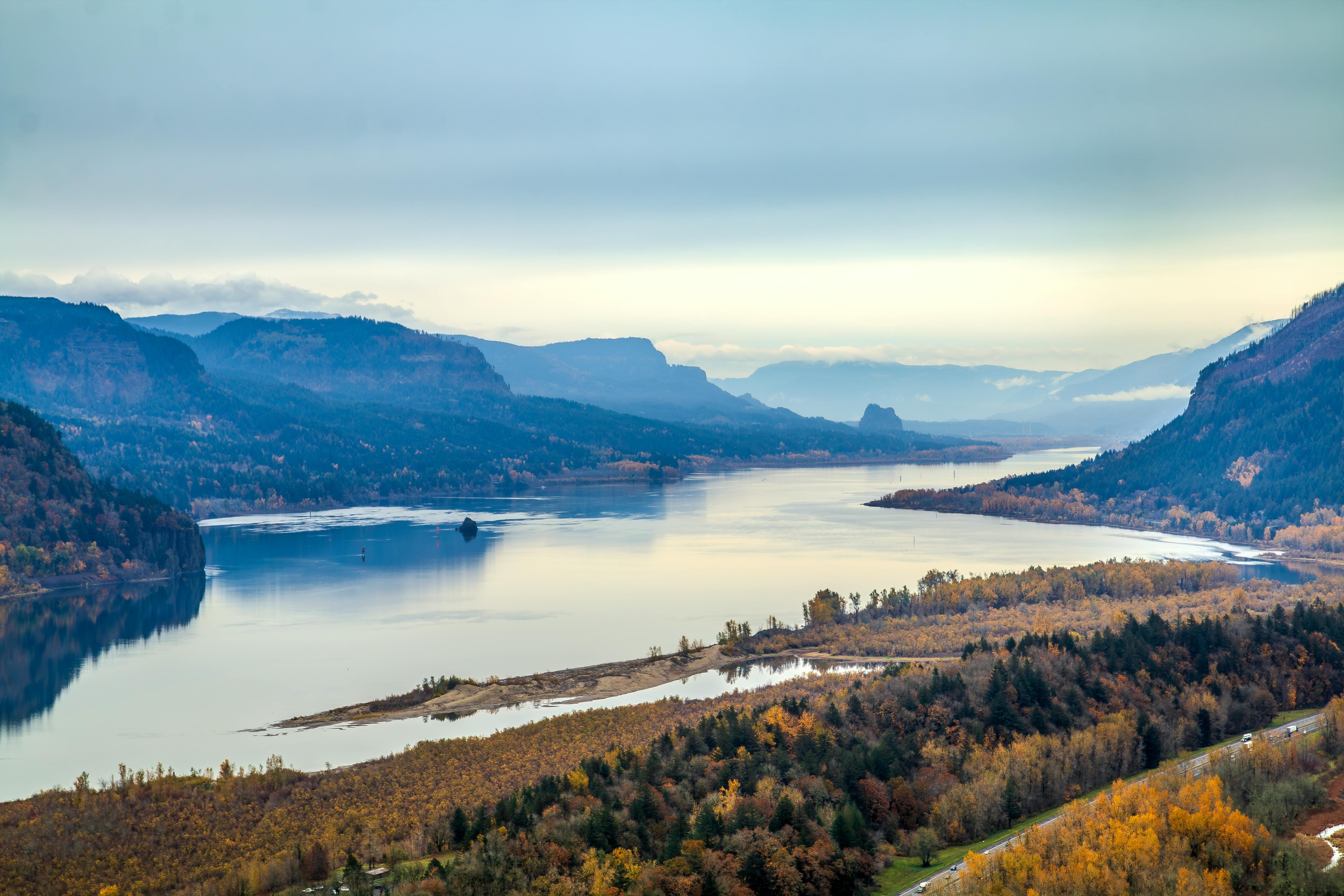
Photo by Liz Lauren, Columbia River Gorge, Oregon
The most beautiful writing about the most beautiful place. The yearning of the soul to be in a place it can rest is so present in this piece. Thank you.